Summary
✓Reviewed by Laura Bennett If you have ever finished a long gaming session with burning, tired eyes and a dull headache behind your brow, you have already felt the problem the 20-20-20 rule for gaming is designed to address. The...
Table of contents
- 1 Why Gamers Get Eye Strain in the First Place
- 2 A Brief History of the 20-20-20 Rule
- 3 How the 20-20-20 Rule Works: The Science Behind It
- 4 Does the 20-20-20 Rule Actually Work? What the Evidence Says
- 5 How to Apply the 20-20-20 Rule While Gaming
- 6 Monitor Setup Tips That Support the Rule
- 7 20-20-20 Rule vs. Other Eye-Break Strategies: Comparison
- 8 Gaming Behavior Data: Why This Matters Now
- 9 Additional Habits That Work Alongside the 20-20-20 Rule
- 10 Frequently Asked Questions
- 10.1 Does the 20-20-20 rule have to be exactly 20 minutes and 20 seconds?
- 10.2 What counts as “20 feet away” indoors?
- 10.3 Can I use the 20-20-20 rule during competitive ranked matches?
- 10.4 Will blue-light glasses eliminate the need for the 20-20-20 rule?
- 10.5 Is the 20-20-20 rule only relevant for PC gamers?
- 10.6 How quickly will I notice a difference if I start using the rule?
- 11 Key Takeaways
- 12 Sources
If you have ever finished a long gaming session with burning, tired eyes and a dull headache behind your brow, you have already felt the problem the 20-20-20 rule for gaming is designed to address. The rule is simple: every 20 minutes of screen time, look at something roughly 20 feet away for 20 seconds. That brief visual reset is one of the most widely recommended habits in eye care for screen users, and according to the American Optometric Association, it applies directly to gaming — specifically between matches, during loading screens, and at any natural pause in play.
Why Gamers Get Eye Strain in the First Place
Digital eye strain (also called computer vision syndrome) develops when the ciliary muscles inside each eye — the muscles that squeeze the lens to change focus — are held in one position for too long. Gaming typically locks your focus at monitor distance, usually around 20 to 30 inches from your face, for sessions that can last hours. The AOA’s gaming guidance notes that sustained near focus is the root cause of the soreness, blurring, and headaches players often notice after long sessions. Screen glare, reduced blinking rates, and poor ambient lighting compound the problem.
A Brief History of the 20-20-20 Rule
The rule did not originate in gaming culture. It emerged in optometry as a practical memory aid for office workers and computer users in the early days of widespread screen adoption. The 2023 PubMed Central review on the 20/20/20 rule traces the recommendation to clinical guidelines aimed at reducing occupational eye strain in desk workers, long before gaming became the dominant leisure screen activity it is today. As gaming sessions grew longer and more immersive through the 2000s and 2010s, optometry organizations including the AOA adapted the rule explicitly to gaming contexts, recognizing that players often exhibit even less blinking and fewer natural visual breaks than traditional computer users.
How the 20-20-20 Rule Works: The Science Behind It
When you stare at a nearby screen, your ciliary muscles contract and hold a sustained near-focus position. Shifting your gaze to a distant object — approximately 20 feet away — forces those muscles to release the tension and return to a relaxed, flatter lens shape. Twenty seconds is long enough for the muscles to fully reset without being an impractical interruption. The PMC review also highlights a secondary benefit: shifting focus to a distant point tends to restore a more natural blink rate, which helps maintain the tear film on the eye surface and counteracts the dryness that comes from staring at a bright display.
Does the 20-20-20 Rule Actually Work? What the Evidence Says
The honest answer is: the evidence is mixed. The rule is widely recommended by major optometry organizations, but a controlled clinical study published on PubMed and titled “20-20-20 Rule: Are These Numbers Justified?” found no statistically significant effect of scheduled 20-second breaks on reported symptoms (P = .70), reading speed (P = .93), or task accuracy in its trial. The study’s authors concluded that the 20-20-20 rule as a standalone timed intervention was not clearly supported as a therapeutic measure for digital eye strain under those conditions.
That does not mean the rule is useless — it means the specific numbers (exactly 20 minutes, exactly 20 seconds) may matter less than the underlying behavior: regularly breaking near focus and allowing your eyes to rest. The AOA and the broader optometry community continue to recommend it as a practical, low-effort habit that costs nothing and carries no risk of harm. The current consensus is to treat it as a flexible rhythm rather than a strict timer.
The specific numbers may matter less than the underlying habit — regularly breaking near focus so your ciliary muscles can rest is the point, whether that happens at minute 18 or minute 22.
How to Apply the 20-20-20 Rule While Gaming
The biggest practical barrier for competitive or immersive players is that stopping mid-game is not always feasible. The good news is that modern games offer plenty of natural pause points that align well with the 20-minute cycle:
- Between matches — the AOA specifically names this window as the ideal moment for a 20-20-20 break during gaming sessions.
- Matchmaking and lobby wait times in games like Valorant, Apex Legends, or League of Legends routinely run 20 to 90 seconds — more than enough time.
- Loading screens in open-world games like Elden Ring or Cyberpunk 2077 are a natural opportunity to look across the room.
- Respawn timers in battle royale or team-based shooters give you 10 to 20 seconds of screen inactivity.
- Cutscenes and dialogue sequences in RPGs let you divert your gaze without missing any player-controlled action.
If you tend to lose track of time during long open-world or single-player sessions, a simple phone timer or the built-in screen time reminders on PlayStation 5 and Nintendo Switch 2 can serve as a lightweight prompt. The goal is to make the break feel automatic, not disruptive. If you are serious about long-term eye health during extended play, pairing the 20-20-20 rule with the broader focus and session management habits covered on The Play Journal will give you a complete framework rather than a single isolated tip.
Monitor Setup Tips That Support the Rule
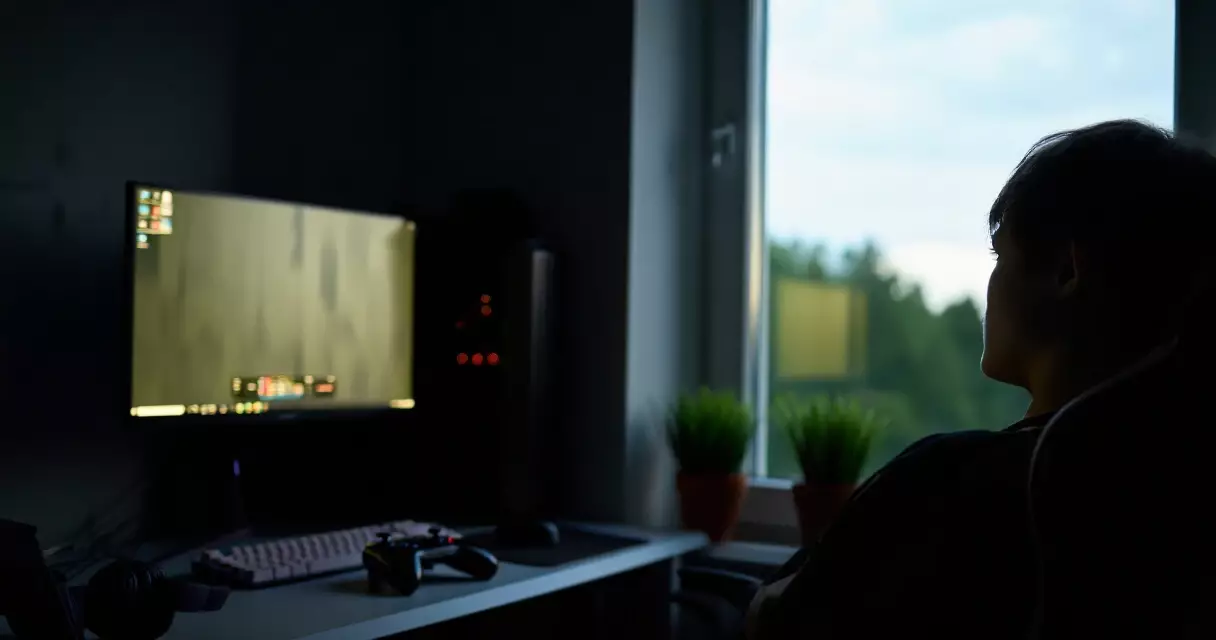
The 20-20-20 rule works best when your baseline setup is already minimizing unnecessary eye strain. The AOA recommends placing your monitor 20 to 30 inches from your face and positioning the top of the screen at or just below eye level, so your gaze angles slightly downward. This reduces the exposed surface area of the eye (which reduces evaporation from the tear film) and keeps the neck in a neutral position.
Beyond distance and angle, matching your screen brightness to the ambient light in the room reduces the contrast burden on the retina. If your room is dim and your monitor is blazing at full brightness, your eyes are working harder every second. Many modern gaming monitors, including high-refresh OLED panels now common on the Steam Deck OLED and large-screen displays, offer adaptive brightness modes that make this easier to manage automatically.
20-20-20 Rule vs. Other Eye-Break Strategies: Comparison
| Strategy | Frequency | Duration | Best For | Evidence |
|---|---|---|---|---|
| 20-20-20 rule | Every 20 min | 20 sec | Any gaming session | Widely recommended by AOA; one PubMed trial found no significant symptom benefit |
| Hourly full break | Every 60 min | 5–10 min | Marathon sessions (3+ hours) | AOA and vision researchers recommend longer breaks alongside the 20-20-20 rule |
| Blink exercises | As needed | 10–15 sec | Dry-eye management | Supported for tear film maintenance; complements the 20-20-20 approach |
| Blue-light filter glasses | Continuous | Ongoing | Reducing light-spectrum fatigue | Evidence is mixed; the AOA does not currently endorse them as a primary solution |
Gaming Behavior Data: Why This Matters Now
The urgency of eye-break habits has grown alongside gaming time itself. According to a 2023 international survey published in PMC, 74.6% of respondents reported increasing their gaming time during the pandemic period, with casual gamers averaging 73.5% more hours per day and competitive gamers averaging 75.8% more. Even as play patterns have normalized somewhat since then, the baseline has shifted upward — more people are gaming for longer stretches than they were five years ago, which means eye health habits that were once occasional considerations are now daily necessities for a large portion of the player population.
With over 214 million video game players in the U.S. and session lengths rising, eye-break habits have moved from optional hygiene to practical necessity for anyone who games regularly.
Additional Habits That Work Alongside the 20-20-20 Rule
The 20-20-20 rule is most effective when it sits inside a broader session hygiene routine. Optometrists and gaming health advocates commonly recommend pairing it with:
- Keeping the room well-lit so the monitor is not the only light source, which reduces the high-contrast glare effect.
- Taking at least one 10-minute full break away from the screen after every two hours of continuous play.
- Staying hydrated — dehydration reduces tear production and worsens dry-eye symptoms during long sessions.
- Sleeping enough each night, as sleep deprivation independently accelerates eye fatigue onset during subsequent gaming.
- Using artificial tear drops if persistent dryness is an issue, particularly in air-conditioned rooms with low humidity.
| Session Length | Recommended 20-20-20 Breaks | Full Breaks Recommended | Total Eyes-Off Time |
|---|---|---|---|
| 1 hour | 3 | 0 | ~1 min |
| 2 hours | 6 | 1 (5–10 min) | ~7–9 min |
| 4 hours | 12 | 2 (5–10 min each) | ~14–18 min |
| 8 hours | 24 | 4 (5–10 min each) | ~28–36 min |
For players who stream or play alongside others — co-op sessions on Steam, for example, or group playthroughs — coordinating break timing with teammates or co-players makes it far easier to step away without feeling like you are slowing the group down. The social dimension of gaming can actually work in your favor here.
Frequently Asked Questions
Does the 20-20-20 rule have to be exactly 20 minutes and 20 seconds?
No. The numbers are a memory aid, not a clinically precise prescription. The underlying goal is to break near focus regularly and look at a distant object long enough for the ciliary muscles to fully relax. A break at 18 minutes or held for 25 seconds achieves the same effect. As the PubMed study on whether the rule’s numbers are justified found, the exact timing matters less than the habit itself being practiced consistently.
What counts as “20 feet away” indoors?
Most standard rooms are 12 to 15 feet across, so looking out a window at trees, a building across the street, or any object at the far end of a long hallway will provide sufficient focal distance. The key is shifting from near focus to far focus — the exact distance is approximate. Even 15 feet is far enough to let the ciliary muscles relax meaningfully compared to screen distance.
Can I use the 20-20-20 rule during competitive ranked matches?
In most competitive titles, yes — the rule is designed to fit into natural pauses, not interrupt active play. Use it during the pre-game lobby, the death/respawn phase, a teammate’s turn in a turn-based game, or the post-round scoreboard. The AOA explicitly recommends applying the rule between matches, which fits naturally into most ranked queue formats.
Will blue-light glasses eliminate the need for the 20-20-20 rule?
No. Blue-light blocking glasses address one specific component of screen-related eye stress related to light spectrum, and their evidence base is mixed. They do nothing to relieve the muscle fatigue caused by sustained near focus, which is the primary driver of gaming eye strain. The 20-20-20 rule targets that muscle fatigue directly, making it a distinct and necessary complement to any lens solution.
Is the 20-20-20 rule only relevant for PC gamers?
Not at all. It applies equally to console players on televisions, handheld gamers on devices like the Nintendo Switch 2 or Steam Deck, and mobile players. Any sustained near-focus screen use creates the same muscle fatigue pattern, regardless of the platform. Handheld gaming is arguably higher-risk because players hold the screen even closer to their face than a typical monitor setup.
How quickly will I notice a difference if I start using the rule?
Most players report a reduction in end-of-session eye soreness and headaches within the first week of consistent use, though individual response varies. The rule does not cure pre-existing eye conditions or correct refractive errors — if symptoms are severe or persistent, an optometrist should be consulted regardless of break habits. Treat the 20-20-20 rule as preventive maintenance, not a treatment.
Key Takeaways
The 20-20-20 rule for gaming is one of the most practical, zero-cost habits any player can adopt. It asks very little — a glance across the room for 20 seconds every 20 minutes — and it directly addresses the ciliary muscle fatigue that causes most gaming-related eye discomfort. The American Optometric Association recommends it explicitly for gamers, and with over 214 million players in the U.S. spending more time in front of screens than ever before, building this habit now is smarter than waiting for symptoms to worsen.
- Every 20 minutes, look at something 20 feet away for 20 seconds.
- Use natural game pauses — matchmaking, loading screens, respawns, cutscenes — to take the break without interrupting play.
- Pair it with proper monitor distance (20–30 inches), good room lighting, and hourly full breaks for longer sessions.
- Blue-light glasses do not replace the rule; they target a different component of eye stress.
- Book a comprehensive eye exam annually — uncorrected refractive errors amplify all forms of digital eye strain.
Sources
- American Optometric Association — The Effects of Gaming and Ways to Combat Eye Stress — retrieved August 2, 2026
- PMC — The 20/20/20 Rule: Practicing Pattern and Associations with Asthenopic Symptoms (2023) — retrieved August 2, 2026
- PubMed — 20-20-20 Rule: Are These Numbers Justified? (2023) — retrieved August 2, 2026
- Entertainment Software Association — 2020 Essential Facts About the Video Game Industry — retrieved August 2, 2026
- PMC — Gaming in Pandemic Times: An International Survey (2023) — retrieved August 2, 2026