
Summary
✓Reviewed by Laura Bennett How do video game remasters differ from remakes? It is one of the most debated questions in gaming, and for good reason: publishers use the two terms almost interchangeably in marketing, yet the technical and creative...
Table of contents
- 1 The Core Definitions: What Each Term Actually Means
- 2 A Brief History: How Remasters and Remakes Evolved
- 3 How Do Video Game Remasters Differ from Remakes? A Side-by-Side Breakdown
- 4 Real-World Examples: Where the Line Becomes Clear
- 4.1 Classic Remasters
- 4.2 Clear Remakes
- 5 How Do Video Game Remasters Differ from Remakes in Terms of Cost and Risk?
- 6 The Grey Zone: When a Remaster Becomes a Remake
- 7 How Do Video Game Remasters Differ from Remakes in the Current Market?
- 8 Why Publishers Choose One Format Over the Other
- 9 Frequently Asked Questions
- 9.1 Is a remake always better than a remaster?
- 9.2 Do remakes cost more to buy than remasters?
- 9.3 Can a remaster change gameplay?
- 9.4 Why are there so many remakes and remasters right now?
- 9.5 What is the difference between a remaster and a reboot?
- 9.6 Are remakes more faithful to the original than remasters?
- 10 Key Takeaways
- 11 Sources
How do video game remasters differ from remakes? It is one of the most debated questions in gaming, and for good reason: publishers use the two terms almost interchangeably in marketing, yet the technical and creative gulf between them can be enormous. A remaster of a beloved classic and a full remake of that same game can feel like entirely different products — because, under the hood, they often are.
The Core Definitions: What Each Term Actually Means
The clearest academic framework comes from game scholars Grabarczyk and Aarseth, whose formal classification distinguishes the two formats by their relationship to original code and design. A remaster retains significant portions of the original game’s code and mechanics while upgrading presentation — higher resolutions, improved frame rates, rebalanced audio, and sometimes minor quality-of-life tweaks. A remake, by contrast, is built on new code and meaningfully changes the game’s technology and often its design, while remaining recognizably tied to the source material rather than functioning as a wholly new installment.
In practical terms: if you played the original and then played the remaster back-to-back, the moment-to-moment gameplay should feel nearly identical. If you played the original and then the remake, you might notice different controls, restructured levels, expanded story beats, or overhauled combat systems — even if the narrative arc and setting remain familiar.
A Brief History: How Remasters and Remakes Evolved
The practice of revisiting older titles is nearly as old as the industry itself, but it accelerated meaningfully in the mid-2000s when HD television sets became mainstream and publishers saw an opportunity to re-release PlayStation 2 and GameCube-era games at higher resolutions. Sony’s “HD Collections” — packaging updated versions of God of War, Ico, Shadow of the Colossus, and the Metal Gear Solid series — established the modern remaster template around 2011–2012. Full remakes had earlier precedents, including Capcom’s GameCube remake of the original Resident Evil in 2002, but it was the Resident Evil 2 Remake in 2019 that demonstrated the format’s commercial ceiling, eventually reaching tens of millions of units and catalyzing a wave of full rebuilds across the industry. According to Virtuos, whose 2025 report analyzed over 200 remakes and remasters with sales data stretching back to 2012, the industry now produces roughly 200 such releases per year.
How Do Video Game Remasters Differ from Remakes? A Side-by-Side Breakdown
The table below captures the defining characteristics that separate the two formats, based on the academic and industry frameworks used by researchers including Logan Brown (SAGE Journals, 2024) and the Grabarczyk–Aarseth classification.
| Dimension | Remaster | Remake |
|---|---|---|
| Underlying code | Original code retained or lightly modified | New engine or substantially rewritten codebase |
| Visual upgrade | Resolution bump, texture upscaling, lighting pass | Fully rebuilt art assets; often photorealistic rework |
| Core gameplay | Preserved — same mechanics, same physics | Often revised: new combat, movement, or camera systems |
| Level design | Identical to original | May be restructured, expanded, or redesigned |
| Story/narrative | Unchanged | May add, cut, or alter story content |
| Development cost | Lower — faster to produce | Higher — closer to a new game in scope |
| Commercial upside | Moderate | Higher — 2.2× average spend per Ampere Analysis |
| Risk level | Lower | Higher — fan expectations are steeper |
Real-World Examples: Where the Line Becomes Clear
Classic Remasters
The The Last of Us Part I (2022) is a useful case study in why labeling matters. Sony positioned it as a “rebuilt from the ground up” release, yet many critics noted the gameplay remained structurally identical to the 2013 original, prompting debate about whether it was truly a remake or an aggressive remaster. By contrast, Demon’s Souls (2020, Bluepoint Games) rebuilt all visual assets completely while keeping FromSoftware’s original gameplay nearly untouched — widely agreed to be a remaster in practice, whatever the marketing said. The Grand Theft Auto: The Trilogy – The Definitive Edition (2021) represents a more typical remaster: updated visuals and controls layered over original code, though its rocky launch illustrated how even light technical work can go wrong.
Clear Remakes
The Resident Evil 2 Remake (2019) and Resident Evil 4 Remake (2023) are the most commercially cited examples. Both scrapped the original fixed-camera or over-the-shoulder perspective in favor of a modern third-person system, rewrote dialogue and cutscenes, redesigned enemy behavior, and added entirely new sub-areas. According to data cited by Inven Global, the Resident Evil 4 Remake reached approximately 16.8 million lifetime units, demonstrating the commercial ceiling available to a well-executed full rebuild. Final Fantasy VII Remake (2020) went further still, expanding a single disc of the 1997 original into a multi-part series with altered story beats — a reminder that the remake format grants developers significant creative latitude.
How Do Video Game Remasters Differ from Remakes in Terms of Cost and Risk?
Remasters are categorically cheaper and faster to produce than remakes. Because they retain the original code, developers largely avoid re-engineering core systems — pathfinding, physics, collision detection — from scratch. The work centers on asset upgrades: higher-resolution textures, relit environments, re-recorded audio, and compatibility patches for modern hardware. A small team can produce a competent remaster in one to two years.
Remakes are closer in scope to a new game. Rebuilding on a modern engine, redesigning gameplay systems, and re-creating (or expanding) all art assets demands a substantially larger team and timeline. That elevated investment is reflected in pricing — remakes frequently launch at full new-game price points, while remasters often land at a mid-tier or budget price. For players considering a purchase, this cost structure is a useful heuristic: a full-price “remaster” warrants scrutiny about what has actually been rebuilt.
On the risk side, remakes carry higher fan-expectation stakes. Changing mechanics or narrative in a beloved classic risks alienating the audience the publisher is trying to attract. A remaster that faithfully preserves the original carries much lower creative risk — even if the technical execution is poor, the underlying game is a known quantity. For publishers working with less-established back-catalog IP, the remaster format’s lower risk profile can make it the pragmatic choice even if the per-unit revenue ceiling is lower. This calculus is explored in depth in the Virtuos 2025 industry report, which analyzed over 200 titles to map the variables that predict commercial success for each format.
“The average remake generated 2.2 times more consumer spending than the average remaster” — Ampere Analysis, tracking 42 releases across Xbox, PlayStation, and Steam from January 2024 to September 2025.
The Grey Zone: When a Remaster Becomes a Remake
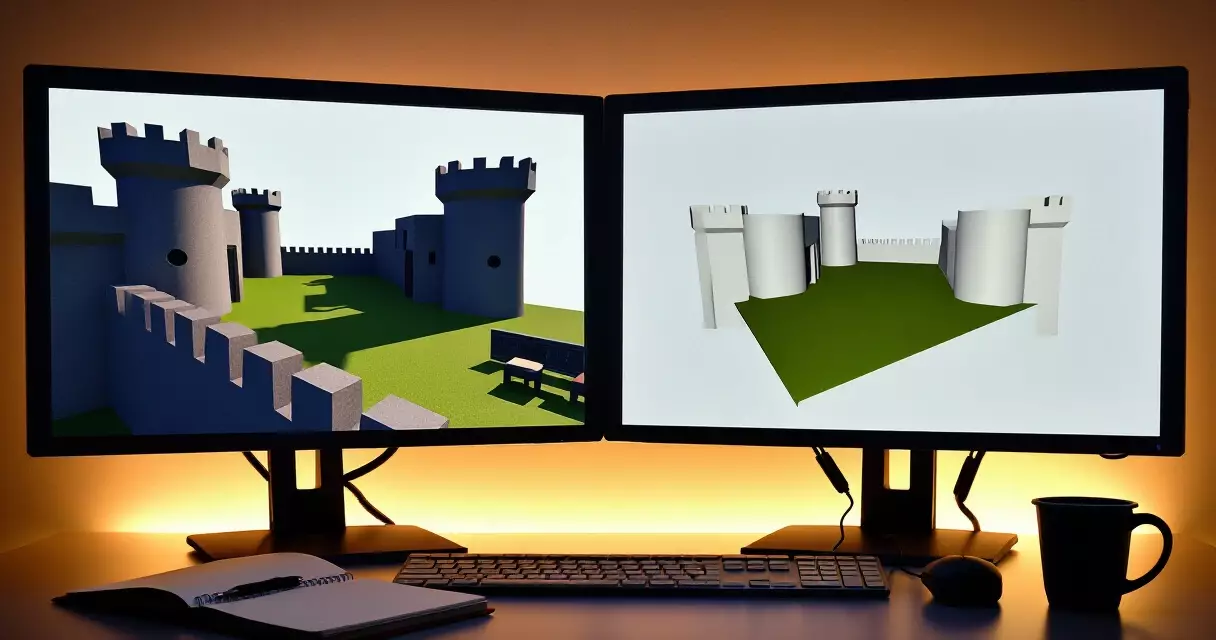
The boundary between remaster and remake is genuinely blurry in a subset of releases. A 2025 thesis published through Charles University in Prague (Jakub Vařeka) argues that a remake is defined by taking “enough technical or storytelling liberties to distinguish itself from the original beyond simple graphical enhancements or newer hardware optimization” — but acknowledges that “enough” is inherently subjective. Industry trade publication GamesPress reported in September 2025 on a “Remake vs. Innovate” survey that used explicit working definitions: remakes are built from scratch with updated graphics, gameplay, and sometimes story; remasters improve visuals, sound, and performance without altering the core design. Even with agreed definitions, borderline cases persist.
Metroid Prime Remastered (2023) sits squarely in the remaster camp — identical mechanics, rebuilt visuals. Dead Space (2023) is clearly a remake — rebuilt on a new engine, with expanded narrative and revised level geometry. But releases like System Shock (2023) fall between the poles: rebuilt on a new engine, but with mechanics intentionally preserved to honor the original. Publishers increasingly use “reimagining” to sidestep the debate entirely, though that term carries its own ambiguity. For consumers, the practical question is always: how much of the original experience is retained, and how much is transformed?
How Do Video Game Remasters Differ from Remakes in the Current Market?
As of August 2026, the remake and remaster market is in what Virtuos has called a “golden age.” According to Sensor Tower data compiled in 2026, roughly 138 million downloads of remakes and remasters were recorded worldwide in 2025 — approximately 60 million remakes and 78 million remasters by download count, suggesting remasters still lead on volume while remakes lead on revenue.
The share of older IP in high-quality releases is also growing. According to reporting by Inven Global in 2026, 16 of the 50 highest-rated games in 2025 were older titles, and the combined share of remakes, remasters, and re-releases among top-rated releases rose to 32 percent in 2025, up from 20 percent in 2024. This trend reflects broader industry dynamics: rising new-game development costs, longer production cycles, and publishers’ preference for IP with proven audience appeal over unproven new concepts.
For players keeping pace with the latest platform hardware — including those evaluating whether the PlayStation 5 Pro is worth the upgrade — remasters and remakes are a key part of the value proposition: they give new-hardware owners a chance to experience beloved back-catalog titles at their technical best.
| Format | 2025 Downloads (worldwide) | Titles in Ampere 2024–2025 Sample | Relative Avg. Spend |
|---|---|---|---|
| Remakes | ~60 million (Sensor Tower) | 15 of 42 | 2.2× vs. remaster baseline (Ampere Analysis) |
| Remasters | ~78 million (Sensor Tower) | 27 of 42 | 1× baseline (Ampere Analysis) |
Why Publishers Choose One Format Over the Other
Budget and IP value are the two primary variables. A publisher sitting on a franchise with a passionate but aging fanbase and limited new-generation audience may opt for a remaster: it is less expensive, carries lower creative risk, and allows the publisher to test whether enough demand exists to justify a full remake later. Capcom’s approach to the Resident Evil franchise illustrates this: the series received HD remasters of older entries before the studio committed to full rebuilds of RE2, RE3, and RE4.
For IP with broad cultural recognition — franchises whose names alone carry marketing weight — a full remake becomes a stronger investment. The higher development cost is offset by the larger addressable audience (existing fans plus players who never played the original) and the higher per-unit revenue ceiling. According to academic research by Logan Brown (SAGE Journals, 2024), publishers increasingly use both formats as tools to “re-valorize” older software for new market conditions — attracting aging fans and newer players with different expectations simultaneously.
“In 2025, 16 of the 50 highest-rated games were older titles, and the share of remakes, remasters, and re-releases among top-rated releases rose to 32 percent — up from 20 percent in 2024.” — Inven Global, 2026.
Platform strategy also plays a role. When a new console generation launches — such as the Nintendo Switch 2 — publishers historically use remasters and remakes to fill the early software library while first-party and third-party new titles are still in production. Remasters are particularly suited to this window because they can be delivered faster.
Frequently Asked Questions
Is a remake always better than a remaster?
Not necessarily — it depends on what you value. A remake delivers a more modern experience with updated mechanics and visuals, but it can also change things you loved about the original. A remaster preserves the original experience more faithfully while making it playable on modern hardware. Neither format is objectively superior; they serve different goals.
Do remakes cost more to buy than remasters?
Generally, yes. Remakes typically launch at full new-game price (currently $60–$70 USD for premium titles) because their development scope is comparable to a new game. Remasters more commonly launch at $20–$40, or as part of bundled collections, though premium remasters of high-demand titles can reach full price.
Can a remaster change gameplay?
Minor quality-of-life changes — adjusted control layouts, toggled difficulty options, camera tweaks — can appear in remasters without moving them into remake territory. Substantive changes to core mechanics, combat systems, or level design typically cross the line into remake. That said, the boundary is not legally or industrially regulated; publishers define it as they see fit.
Why are there so many remakes and remasters right now?
Rising new-game development costs, longer production timelines for original titles, and the financial safety of known IP are the main drivers. Publishers can reach both nostalgic fans and new-generation players with a single release, often at lower marketing cost than a new IP. According to the Ampere Analysis report, 72.4 million players engaged with remakes and remasters across Xbox, PlayStation, and Steam between January 2024 and September 2025 — confirming the audience is substantial.
What is the difference between a remaster and a reboot?
A reboot is distinct from both: it reimagines the franchise’s tone, setting, or continuity rather than revisiting a specific original title. God of War (2018) is commonly cited as a reboot — it kept the character but fundamentally reset his story and world. Remasters and remakes both stay anchored to a specific earlier release; reboots are free to depart more radically from the source material.
Are remakes more faithful to the original than remasters?
Counterintuitively, remasters are often more faithful to the original experience because they preserve the original code and mechanics. Remakes, by definition, take liberties with the technology and sometimes the design. A remaster gives you the same game looking better; a remake gives you a new interpretation of that game. Whether that interpretation is more or less “faithful” is a creative judgment call that varies by release.
Key Takeaways
- A remaster preserves the original code and gameplay while upgrading presentation; a remake rebuilds the game on new technology and often redesigns its systems.
- According to Ampere Analysis, remakes generate on average 2.2 times more consumer spending than remasters, based on 42 titles tracked between January 2024 and September 2025.
- Remasters are cheaper and faster to produce, making them the pragmatic choice for lower-profile IP or early console-generation library filling.
- Marketing labels are not regulated — assess a release by what was actually rebuilt, not what the publisher calls it.
- The remaster and remake market is growing: roughly 138 million downloads worldwide in 2025, and older titles now accounting for 32 percent of top-rated releases (up from 20 percent in 2024).
Sources
- Grabarczyk & Aarseth — Remakes, Remasters, and Paratextual Revisits (DiGRA) — Retrieved August 19, 2026
- Logan Brown — Rethinking Remakes: Value and Culture in Video Game Temporalization (SAGE Journals, 2024) — Retrieved August 19, 2026
- Video game remake — Wikipedia — Retrieved August 19, 2026
- Ampere Analysis: $1.4bn Was Spent on Remakes and Remasters in 2024–2025 (Games Market Global) — Retrieved August 19, 2026
- The Golden Age of Video Game Remakes and Remasters — Virtuos (2025) — Retrieved August 19, 2026
- The Golden Age of Remakes: Why Game Companies Are Looking to the Past — Inven Global (2026) — Retrieved August 19, 2026
- Video Game Remakes & Remasters Statistics 2026 — Shane the Gamer (Sensor Tower data) — Retrieved August 19, 2026