Summary
✓Reviewed by Laura Bennett MyRepublic, the Singapore-based telecommunications provider, announced the launch of Hyperpeer on September 2, 2026 — a dedicated game acceleration service available to gamers across Singapore and Malaysia, regardless of which internet service provider they use, with...
Table of contents
MyRepublic, the Singapore-based telecommunications provider, announced the launch of Hyperpeer on September 2, 2026 — a dedicated game acceleration service available to gamers across Singapore and Malaysia, regardless of which internet service provider they use, with the company claiming the service can deliver up to a 30% reduction in ping latency.
The launch marks a significant move by a regional ISP to compete directly in the performance-enhancement space that has largely been dominated by third-party software tools such as Exitlag and WTFast. Hyperpeer works by optimising game-related network routing for supported online titles, rerouting traffic through MyRepublic’s own infrastructure to reduce packet loss and latency spikes that commonly affect competitive and online multiplayer gaming.
What Hyperpeer Does and Who It Is For
According to MyRepublic’s official announcement, Hyperpeer is designed specifically to address one of the most persistent frustrations for online gamers in Southeast Asia: unstable routing paths between consumer connections and game servers hosted in Asia-Pacific, North America, and Europe. The service “optimises gaming-related routing for supported online games,” MyRepublic stated in its press release, and is aimed at reducing the high and inconsistent ping times that can make competitive titles such as Valorant, League of Legends, and Call of Duty difficult to play at a high level.
Critically, Hyperpeer is not restricted to MyRepublic broadband subscribers. The company confirmed the service is “open to gamers regardless of which internet service provider they use” — positioning it as a standalone product that can be purchased by anyone on Singapore or Malaysian broadband, whether they are on Singtel, StarHub, M1, or another network. This ISP-agnostic approach is a notable departure from typical bundled telco gaming perks and could widen Hyperpeer’s addressable market considerably.
Performance Claims: Up to 30% Ping Reduction
The headline performance claim from MyRepublic is a “up to 30% reduction in ping” for supported games. The company has not, as of September 2, 2026, published independent third-party benchmarks or detailed methodology to substantiate this figure — the 30% claim is based on MyRepublic’s own internal testing. Gamers and reviewers should treat this as a best-case marketing figure until independent testing is available. For context on how network-layer optimisation compares to local hardware performance, our earlier breakdown of cloud gaming versus local gaming in 2026 covers the fundamental latency trade-offs in detail.
Ping reduction tools of this type work by bypassing congested public internet backbone routes and sending traffic through a private, optimised relay network. The effectiveness varies significantly by game, target server region, and time of day. Users in Singapore connecting to Southeast Asia servers — common for games like Mobile Legends: Bang Bang and Valorant on Asia servers — may see different results than those connecting to US or European servers. MyRepublic has not yet detailed a full list of supported games or server regions.
Pricing and Bundling Details
MyRepublic confirmed that a 24-month Hyperpeer subscription is included with its GAMER+ Broadband Plans, giving existing and new GAMER+ subscribers access to the service at no additional cost for two years. Standalone pricing for non-MyRepublic subscribers has not been fully disclosed in the launch announcement, and the company has not confirmed a per-month rate for out-of-network users as of the time of publication.
The bundling strategy mirrors how some telcos in the region have attempted to attract and retain gaming-focused households — offering value-adds tied to higher-tier broadband plans rather than competing purely on raw speed. It remains to be seen whether MyRepublic will offer a competitively priced standalone tier that makes Hyperpeer attractive for the large segment of Singapore gamers on competing ISPs.
Context: Singapore’s Competitive Online Gaming Market
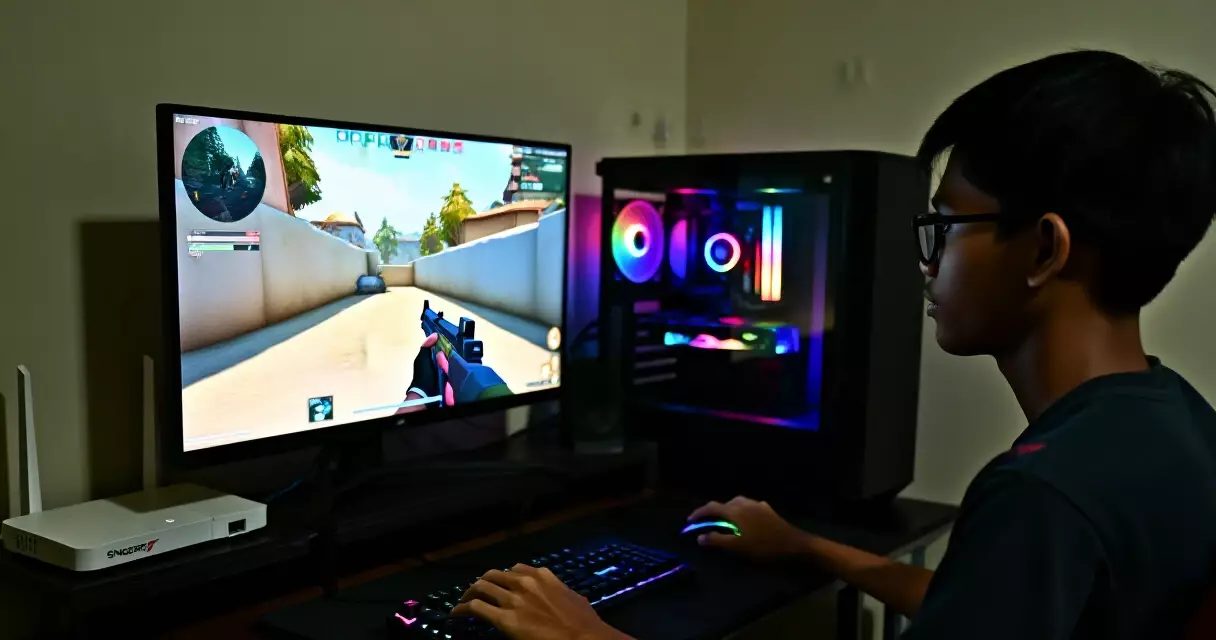
Singapore’s gaming population is among the most connected in Southeast Asia, with near-universal fibre broadband penetration and a large base of competitive and casual online players. Despite fast raw speeds, gamers in the city-state routinely report elevated ping to servers outside of Southeast Asia — a problem rooted in international routing infrastructure rather than local connection quality. Tools that target routing optimisation, rather than raw bandwidth, have historically found a receptive audience in the region.
MyRepublic has long branded itself as a gaming-first ISP in Singapore — a positioning it established during its early growth years by offering uncongested speeds and gaming-specific support. Hyperpeer represents a continuation of that strategy, extending it into a product that can, in theory, generate revenue beyond its own subscriber base. The launch also arrives as Singapore’s gaming ecosystem continues to grow, with multiple game publishers using Singapore as a regional hub and esports infrastructure expanding across the country.
How Hyperpeer Compares to Existing Game Acceleration Tools
| Service | Provider Type | ISP-Agnostic | Bundled with Broadband | Region Focus |
|---|---|---|---|---|
| Hyperpeer (MyRepublic) | Telco | Yes | Yes (GAMER+ plans) | Singapore, Malaysia |
| Exitlag | Third-party software | Yes | No | Global |
| WTFast | Third-party software | Yes | No | Global |
| Singtel GameOn | Telco bundle | No (Singtel only) | Yes | Singapore |
The table above illustrates where Hyperpeer sits in the competitive landscape. Its strongest differentiator relative to telco-bundled competitors is its ISP-agnostic availability; its main challenge versus established third-party tools like Exitlag is building trust with a gaming audience that already has paid subscriptions elsewhere and will need concrete, independently verified performance data before switching.
What Happens Next
Independent community testing of Hyperpeer is likely to emerge on forums such as Reddit’s r/singapore and hardware discussion boards in the coming days, providing real-world data beyond MyRepublic’s own claims. The full list of supported games — and whether popular Southeast Asian titles like Mobile Legends, Valorant, Genshin Impact, and PUBG Mobile are included — will be a key factor in how broadly the service is adopted.
MyRepublic has not confirmed a standalone subscription price for non-GAMER+ users, nor has it provided detail on the number of relay nodes or peering partners underpinning Hyperpeer’s routing infrastructure. Both pieces of information will be essential for gamers and reviewers to assess whether the service can deliver consistent improvements across different game genres and server regions. The announcement was carried by Media OutReach Newswire and picked up by multiple regional outlets on the day of launch.
Key takeaways from the Hyperpeer launch:
- Launched September 2, 2026, for Singapore and Malaysia
- Claims up to 30% ping reduction — MyRepublic’s own figure, independent testing pending
- ISP-agnostic: available to gamers on any broadband provider
- 24-month subscription bundled with MyRepublic GAMER+ Broadband Plans
- Standalone pricing for non-MyRepublic users not yet confirmed
- Supported game list and relay infrastructure details not yet published
Sources
- carried by Media OutReach Newswire — manilatimes.net
- picked up by multiple regional outlets — newspressnow.com
- XTransfer Named to CNBC’s World’s Top Fintech … — bastillepost.com
- MyRepublic’s gaming ping reduction service is now … — hardwarezone.com.sg
- Corporate News From Media OutReach Newswire – Malaysia — malaysiaworldnews.com