
Summary
✓Reviewed by Laura Bennett The Nintendo Switch 2 launch: the story behind its development is one of the most compelling hardware narratives in modern gaming. When Nintendo officially confirmed a 2025 release window on January 16, 2025, it ended years...
Table of contents
- 1 A Console Eight Years in the Making: Nintendo Switch 2 Origins
- 2 The January 2025 Reveal: How Nintendo Broke the News
- 3 April 2, 2025: Pricing, Date, and the Tariff Shadow
- 3.1 What Switch 2 Added Over the Original
- 3.2 The Launch Lineup and Mario Kart World
- 4 June 5, 2025: The Global Launch and Record-Breaking Sales
- 5 The Hybrid Design Philosophy That Shaped Switch 2’s Development
- 6 Navigating Trade Policy: How Tariffs Shaped the Launch Narrative
- 7 Switch 2 in 2026: Momentum, Pokémon, and Global Expansion
- 8 How Switch 2 Compares to Its Predecessor at Launch
- 9 Nintendo Switch 2 Regional Launch Timeline
- 10 Frequently Asked Questions
- 10.1 When did the Nintendo Switch 2 officially launch?
- 10.2 How much did Nintendo Switch 2 cost at launch in the U.S.?
- 10.3 How many Switch 2 units were sold at launch?
- 10.4 What are the key new features of Switch 2 compared to the original?
- 10.5 How did tariffs affect the Nintendo Switch 2 launch?
- 10.6 Is Switch 2 still selling well in 2026?
- 11 Key Takeaways
- 12 Sources
The Nintendo Switch 2 launch: the story behind its development is one of the most compelling hardware narratives in modern gaming. When Nintendo officially confirmed a 2025 release window on January 16, 2025, it ended years of intense speculation about the successor to the original Switch — a platform that, according to Reuters, had already sold 150 million units and transformed how the world thinks about portable-home hybrid gaming. What followed was a carefully orchestrated reveal, a high-stakes pricing announcement, and a global launch that broke Nintendo’s own records.
A Console Eight Years in the Making: Nintendo Switch 2 Origins
The Nintendo Switch 2 launch: the story behind its development begins, in a very real sense, with the launch of the original Switch in March 2017. Nintendo chose not to compete on raw graphical horsepower with Sony and Microsoft — instead, it built a platform that could be played on a TV, undocked as a handheld, and detached into two Joy-Con controllers for local multiplayer. That formula worked beyond almost anyone’s projections. By the time Nintendo began seriously developing a successor, the original Switch had sold 150 million units, according to Reuters, silencing critics who had predicted the concept would fail.
Nintendo’s development philosophy for successors has historically been evolutionary rather than revolutionary. The company — headquartered in Kyoto, Japan — tends to refine proven mechanics rather than reinvent them entirely. That pattern held true with Switch 2: Nintendo kept the core hybrid design while expanding almost every dimension of it, adding a larger display, improved graphics performance, and new social features. The iterative approach also reflected commercial pragmatism: abandoning the hybrid form factor would have meant abandoning the library of Switch games and the audience who loved playing them on the go.
The January 2025 Reveal: How Nintendo Broke the News
On January 16, 2025, Nintendo published a short trailer confirming that a new console — Switch 2 — would launch in 2025. As Reuters reported at the time, the reveal was deliberately light on specifics: no price, no firm date, just a confirmation of the hardware’s existence and its hybrid lineage. The video showed a device that looked unmistakably like a Switch — the same screen-plus-detachable-controllers concept — but with a visibly larger form factor and a new magnetic attachment mechanism for the controllers.
Nintendo’s shares initially fell around 4% on the day of the announcement, with some investors interpreting the cautious reveal as a sign of uncertainty. That reaction, though short-lived, illustrated the enormous pressure Nintendo was under: the original Switch was still selling, and any misstep in the transition could erode the company’s dominant position in handheld gaming. Nintendo’s strategy was to reveal slowly, build anticipation through a series of curated presentations, and then convert that anticipation into day-one demand.
April 2, 2025: Pricing, Date, and the Tariff Shadow
The most consequential pre-launch moment in the Nintendo Switch 2 launch story came on April 2, 2025, when Nintendo held a dedicated Nintendo Direct presentation that finally answered the two questions everyone was asking: how much, and when? According to Reuters, the console would launch on June 5, 2025, priced at $449.99 in the United States, with a Mario Kart World bundle available at $499.99. In Japan, pricing was set in yen at an equivalent tier.
The timing was not without risk. April 2, 2025, was also the day U.S. President Donald Trump announced a sweeping tariff policy that created significant trade uncertainty, particularly for goods manufactured in Asia. Nintendo, like most major electronics companies, relies heavily on manufacturing in the region. Reuters noted that Nintendo disclosed the Switch 2’s pricing on the very same day that U.S. tariff announcements were rolling across financial markets, raising immediate questions about whether supply chains and retail prices could be maintained. Nintendo did not change its announced U.S. price in response to the tariff news, though the episode underlined how deeply interconnected gaming hardware development is with global trade policy.
What Switch 2 Added Over the Original
The April 2025 Nintendo Direct also clarified what buyers were actually getting for the higher price. Per reporting from both AP and Reuters, Switch 2 retained the fundamental hybrid concept — it can be played on a TV via a dock, as a portable handheld, or with detached controllers in tabletop mode — but delivered a larger display, meaningfully improved graphics performance over the 2017 original, and new social features including interactive chat and screen-sharing capabilities designed to enhance online multiplayer sessions.
The Launch Lineup and Mario Kart World
A hardware launch is only as strong as its software. Nintendo anchored Switch 2’s launch around Mario Kart World — a new entry in the Mario Kart franchise that served as both the system’s flagship title and the centerpiece of the $499.99 bundle. The choice of a Mario Kart game was characteristically Nintendo: the series is approachable, family-friendly, and has proven across multiple generations that it sells hardware. For more on the confirmed Switch 2 software lineup, see our coverage of the Nintendo Switch 2 launch lineup.
June 5, 2025: The Global Launch and Record-Breaking Sales
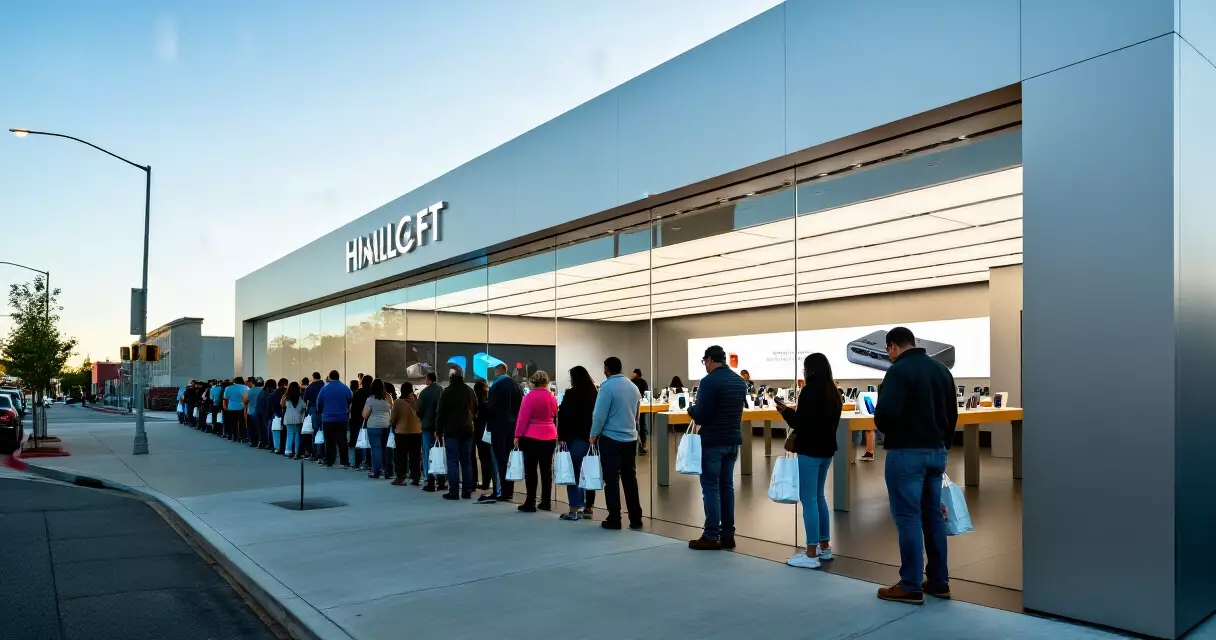
When June 5, 2025 arrived, the Nintendo Switch 2 launch: the story behind its development reached its most public chapter. According to AP, crowds formed outside retailers from Tokyo to New York City in the hours before stores opened, with some fans queuing through the night. Reuters confirmed that shortages were expected even before launch day, reflecting a level of pent-up demand that Nintendo had not seen since the earliest days of the Wii in 2006.
The sales numbers that followed were extraordinary. Within four days of launch, Nintendo reported it had sold more than 3.5 million Switch 2 units — making Switch 2 Nintendo’s fastest-selling console ever, as confirmed by AP. By early August 2025, Reuters reported that total sales had exceeded six million units in the first seven weeks, with Nintendo maintaining its full-year forecast unchanged. The early trajectory put Switch 2 on pace to be one of the best-performing console launches in the industry’s history.
Within four days of launch, Nintendo had sold more than 3.5 million Switch 2 units — setting a new record for the company’s fastest-selling console.
The Hybrid Design Philosophy That Shaped Switch 2’s Development
Understanding the Nintendo Switch 2 launch: the story behind its development requires understanding Nintendo’s broader design philosophy. The company’s internal development culture, centered in Kyoto, has long prioritized novel interaction over specification competition. Where Sony and Microsoft pursued generational leaps in GPU and CPU performance with the PS5 and Xbox Series X, Nintendo invested its R&D resources in refining the hybrid concept it had pioneered in 2017. The magnetic Joy-Con attachment system shown in the January 2025 reveal trailer was a direct evolution of that thinking — solving one of the original Switch’s recurring pain points (Joy-Con drift and connection reliability) through hardware redesign rather than software patches.
The decision to maintain backward compatibility with certain Switch software titles — while introducing a new game card format for Switch 2-native titles — also reflects careful development prioritization. Nintendo needed to protect the value of the existing Switch library for the tens of millions of players who had already invested in it, while also giving publishers and developers a clear reason to build Switch 2-native experiences that showcased the new hardware’s capabilities. That balancing act is one of the central challenges in any console generation transition, and Nintendo’s handling of it in Switch 2’s development is widely regarded as measured and deliberate.
Navigating Trade Policy: How Tariffs Shaped the Launch Narrative
One of the more unusual dimensions of the Nintendo Switch 2 launch story is how closely it intersected with global trade politics. As Reuters reported in April 2025, Nintendo announced its U.S. pricing on the same day sweeping American tariff announcements created volatility in Asian manufacturing supply chains. The $449.99 price point — significantly higher than the original Switch’s launch price of $299.99 — raised questions about how much of that increase reflected hardware improvements versus supply chain cost pressures.
Nintendo did not publicly break down cost components, but Reuters’ Breakingviews column noted in August 2025 that the launch’s impressive performance gave Nintendo meaningful pricing power. The company maintained its original U.S. price even as tariff pressures continued to evolve, suggesting that demand was strong enough to absorb the premium. For context, the PS5 launched at $499.99 in November 2020, so Switch 2’s $449.99 positioned it as a strong value relative to the home console competition while still commanding a significant premium over its predecessor.
Nintendo’s decision to hold the $449.99 price line despite tariff turbulence signaled confidence in the platform’s demand — and that confidence proved justified by record-breaking launch sales.
Switch 2 in 2026: Momentum, Pokémon, and Global Expansion
More than a year after launch, the Nintendo Switch 2 development story continues to evolve. In March 2026, Reuters reported that a Pokémon title — described as a “stealth” release — sold over 2.2 million copies within its launch window, boosting Switch 2 momentum and investor sentiment. The success of a Pokémon game on the new platform was not surprising, but the speed of adoption underscored that the Switch 2 install base had grown large enough to support strong first-week sales for major franchise titles.
Nintendo is also pursuing a deliberate staggered global rollout. According to Reuters reporting from August 12, 2026, Nintendo plans to launch both Switch and Switch 2 in Indonesia in December 2026, marking its first official entry into Southeast Asia’s largest economy. The staggered approach — the Philippines, Singapore, and Thailand received the console in June 2025; Malaysia in July 2025; the UAE in September 2025; Argentina in October 2025 — reflects both supply chain realities and Nintendo’s careful management of retail relationships in emerging markets. As of August 2026, Nintendo’s target is to sell 16.5 million Switch 2 units in the business year through March 2027, per Reuters.
Developers have also responded to the platform’s momentum. The FromSoftware-developed Switch 2 exclusive, The Duskbloods, drew significant attention when The Duskbloods network test selections were announced in August 2026 — a signal that major third-party studios are investing in Switch 2-native exclusives, not just cross-platform ports. Similarly, Kingdom Hearts IV is confirmed for Switch 2 alongside PS5, Xbox, and PC, cementing the platform’s position as a serious destination for major franchises.
How Switch 2 Compares to Its Predecessor at Launch
| Metric | Nintendo Switch (2017) | Nintendo Switch 2 (2025) |
|---|---|---|
| U.S. Launch Price | $299.99 | $449.99 (Reuters, April 2025) |
| Launch Date | March 3, 2017 | June 5, 2025 |
| Units Sold — First 4 Days | Not publicly disclosed | 3.5 million+ (Reuters, June 2025) |
| Units Sold — First 7 Weeks | Not publicly disclosed | 6 million+ (Reuters, August 2025) |
| Flagship Launch Title | The Legend of Zelda: Breath of the Wild | Mario Kart World |
| Key New Features | Hybrid home/handheld design; Joy-Con | Larger display; improved graphics; interactive chat; screen-sharing; magnetic Joy-Con |
| Total Predecessor Sales | N/A (first Switch) | 150 million original Switch units (Reuters) |
Nintendo Switch 2 Regional Launch Timeline
| Region / Country | Launch Date | Source |
|---|---|---|
| Worldwide (most regions) | June 5, 2025 | Reuters / AP |
| Philippines, Singapore, Thailand | June 26, 2025 | Wikipedia (Nintendo Switch 2) |
| Malaysia | July 3, 2025 | Wikipedia (Nintendo Switch 2) |
| Taiwan | July 10, 2025 | Wikipedia (Nintendo Switch 2) |
| United Arab Emirates | September 17, 2025 | Wikipedia (Nintendo Switch 2) |
| Argentina | October 10, 2025 | Wikipedia (Nintendo Switch 2) |
| Indonesia | December 2026 (planned) | Reuters, August 2026 |
Frequently Asked Questions
When did the Nintendo Switch 2 officially launch?
Nintendo Switch 2 launched globally on June 5, 2025, according to Reuters and AP. Most major markets received the console on that date, with a staggered rollout continuing into late 2025 and 2026 for additional regions including Southeast Asia, the UAE, and Argentina.
How much did Nintendo Switch 2 cost at launch in the U.S.?
Nintendo priced the Switch 2 at $449.99 in the United States, with a Mario Kart World bundle available at $499.99, as confirmed by Reuters on April 2, 2025. This represented a $150 premium over the original Switch’s $299.99 launch price.
How many Switch 2 units were sold at launch?
Nintendo sold more than 3.5 million Switch 2 units in the first four days after launch, making it Nintendo’s fastest-selling console ever, per Reuters. By early August 2025, total sales exceeded six million units in the first seven weeks, with Nintendo maintaining its full-year forecast.
What are the key new features of Switch 2 compared to the original?
According to AP and Reuters, Switch 2 added a larger display, improved graphics performance, interactive chat, and screen-sharing features over the original Switch. Nintendo also redesigned the Joy-Con attachment mechanism from slide-in to magnetic, addressing the notorious Joy-Con drift and connection reliability issues that affected the original hardware.
How did tariffs affect the Nintendo Switch 2 launch?
Nintendo announced its U.S. pricing on April 2, 2025, the same day sweeping U.S. tariff announcements created uncertainty in Asian manufacturing supply chains, as noted by Reuters. Nintendo did not alter its announced prices in response, and the platform’s record sales demonstrated that consumer demand was resilient to the premium price point.
Is Switch 2 still selling well in 2026?
Yes. As of August 2026, Nintendo’s full-year sales target is 16.5 million Switch 2 units through March 2027, according to Reuters. A Pokémon title released in early 2026 sold over 2.2 million copies in its launch window, per Reuters, signaling continued strong platform momentum well into the console’s second year.
Key Takeaways
- The Nintendo Switch 2 launch: the story behind its development is rooted in Nintendo’s evolutionary design philosophy — improving what worked rather than reinventing it.
- Nintendo’s staged reveal strategy (January 2025 announcement, April 2025 pricing, June 2025 launch) maximized sustained media attention and day-one demand.
- According to Reuters, Switch 2 sold over 3.5 million units in four days and over 6 million units in seven weeks — both records for Nintendo.
- Global tariff uncertainty in April 2025 created launch risk that Nintendo managed by holding its $449.99 U.S. price unchanged.
- As of August 2026, Nintendo is targeting 16.5 million Switch 2 unit sales in its current fiscal year, with ongoing regional expansion including a December 2026 Indonesia launch.
Sources
- Reuters — Nintendo to release Switch 2 this year; shares slide 4% — Retrieved August 21, 2026
- Reuters — Nintendo Switch 2 to launch in June with $449.99 price tag — Retrieved August 21, 2026
- Reuters — Nintendo faces trade war test with Switch 2 launch — Retrieved August 21, 2026
- Reuters — Gamers line up for Nintendo Switch 2 on launch day — Retrieved August 21, 2026
- Reuters — Nintendo Switch 2 smashes record as company’s fastest-selling console — Retrieved August 21, 2026
- Reuters — Nintendo reports robust early sales of Switch 2, keeps full-year forecast — Retrieved August 21, 2026
- Reuters Breakingviews — Nintendo can flex its pricing power with Switch 2 — Retrieved August 21, 2026
- Reuters — Stealth Pokémon hit boosts Nintendo Switch 2 momentum sentiment — Retrieved August 21, 2026
- Reuters — Nintendo to launch Switch consoles in Indonesia in December — Retrieved August 21, 2026
- AP — Fans around the world queue up for Nintendo Switch 2 — Retrieved August 21, 2026
- AP — Nintendo unveils new Switch 2 launch date, price and more — Retrieved August 21, 2026
- AP — Nintendo says sales of its Switch 2 hit a record within four days — Retrieved August 21, 2026
- Wikipedia — Nintendo Switch 2 — Retrieved August 21, 2026