
Summary
Role-playing games have become one of the most commercially dominant genres in the world. According to Statista's 2024 gaming market report, the global RPG segment is valued at $25.4 billion, a figure that reflects not just nostalgia but an enduring...
Table of contents
- 1 A Brief History of RPG Mechanics
- 2 Understanding RPG Stats: The Foundation of Every Character
- 3 How Leveling Systems Work (and Why They Feel So Rewarding)
- 4 Loot Systems: Rarity, Randomness, and the Gear Treadmill
- 5 Combat Systems in RPGs: Turn-Based, Real-Time, and Action Hybrids
- 6 Character Builds, Skill Trees, and Specialization
- 7 Economy, Crafting, and Resource Management
- 8 FAQ – RPG Game Mechanics Explained
- 8.1 What are the core stats in most RPGs?
- 8.2 How does leveling up work in RPGs?
- 8.3 What does “loot rarity” mean in an RPG?
- 8.4 What is the difference between turn-based and action RPG combat?
- 8.5 What is a skill tree and how do I use one?
- 8.6 How do crafting systems work in RPGs?
- 8.7 Are RPG mechanics the same in JRPGs and CRPGs?
- 8.8 What is the best RPG for learning core mechanics?
- 9 Related Reading
- 10 Sources
Role-playing games have become one of the most commercially dominant genres in the world. According to Statista’s 2024 gaming market report, the global RPG segment is valued at $25.4 billion, a figure that reflects not just nostalgia but an enduring appetite for deep, systems-driven gameplay. At the center of that appetite is something deceptively simple: mechanics. The rules, numbers, and feedback loops that govern how your character grows, fights, finds gear, and interacts with the world are the invisible architecture behind every great RPG. Understanding those systems does not just make you a better player – it changes how you see the genre entirely.
A Brief History of RPG Mechanics
The story of RPG mechanics begins not on a screen but around a table. Dungeons & Dragons, published by Gary Gygax and Dave Arneson in 1974, established the foundational vocabulary that still echoes through modern game design: attributes like Strength, Dexterity, and Intelligence; dice-based combat resolution; experience points that trigger character advancement. These were not abstract concepts – they were a systematic attempt to simulate heroic fiction in a rules framework any group could use.
The leap to digital happened faster than most people realize. According to Wikipedia’s entry on role-playing video games, one of the earliest known digital RPGs dates to 1975 with titles running on university mainframes. Programmers saw D&D’s rule-sets as ideal code fodder: numerical stats, conditional logic, lookup tables for combat. The structure translated almost perfectly.
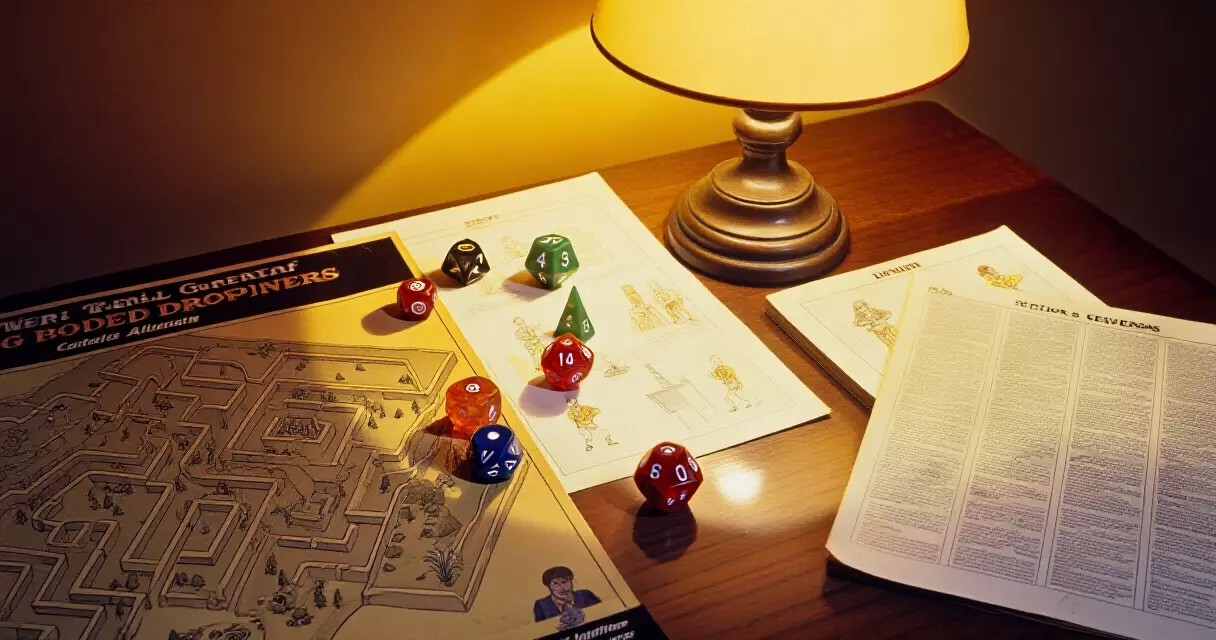
Through the 1980s and 1990s, developers took those tabletop blueprints in diverging directions. Japanese studios like Square built emotionally narrative systems around RPG mechanics, producing Final Fantasy VII’s Materia system – a modular magic framework that remains one of the most beloved in gaming. Western developers leaned into simulation depth, giving players sprawling character builders and morally complex choices. Fallout: New Vegas, released in 2010 by Obsidian Entertainment, is still cited by critics as the high-water mark of skill-check-driven writing, where a single stat point could open or close entire quest lines.
The modern era blends these traditions. Baldur’s Gate 3 from Larian Studios (2023) runs on the D&D 5th Edition ruleset while delivering cinematic production values that rival AAA action titles. Elden Ring grafts RPG stat systems onto an action game framework. Pokémon, a franchise that has sold over 440 million games worldwide according to The Pokémon Company’s official sales data, teaches stat theory and type matchups to children with zero friction. RPG mechanics have become a shared cultural language.
Understanding RPG Stats: The Foundation of Every Character
Every RPG character is, at its core, a collection of numbers. Stats – sometimes called attributes or parameters – are the numerical values that define what your character can do and how well they can do it. They determine whether your sword strike lands, how much damage it deals, whether you can pick a lock or convince a guard to look the other way. Learning to read them is the first real skill any RPG player develops.
The vocabulary varies by game and subgenre, but certain categories appear again and again. Physical offense stats (Strength, Attack, Physical Damage) govern how hard you hit. Defense stats (Armor, Endurance, Resilience) reduce incoming punishment. Agility or Dexterity typically influences attack speed, dodge chance, and critical hit probability. Intelligence or Magic-focused stats scale spell power. Vitality or Constitution controls your health pool.
The Elder Scrolls V: Skyrim simplifies this dramatically compared to its predecessors, collapsing dozens of attributes into three primary pools – Health, Magicka, and Stamina – that the player allocates points into on each level-up. This made Skyrim enormously accessible, but veteran RPG fans noted it came at the cost of character distinctiveness. Earlier Elder Scrolls titles and games like Divinity: Original Sin 2 preserve a wider attribute grid, giving each stat investment genuine weight.
Secondary stats layer on top of primary attributes, and these are where real mechanical depth lives. Critical hit chance and critical hit damage multiplier, for example, create an entire meta-game in Diablo IV around chasing specific gear affixes. Resistances – fire, ice, lightning, poison – determine survivability in elemental-heavy encounters. Status effect chance stats (Bleed, Stagger, Poison buildup in Elden Ring) open up entire playstyle archetypes. A character built around inflicting Bleed in Elden Ring plays completely differently from one stacking Intelligence for sorcery, even at identical level.
Soft caps and hard caps are essential vocabulary here. A soft cap is a point at which additional investment in a stat yields diminishing returns, but not zero returns. A hard cap is an absolute ceiling. Elden Ring’s soft caps for most stats sit at 20, 40, 60, and 80, meaning a player dumping points into Strength above 80 gains almost nothing. Recognizing these thresholds is the difference between an optimized build and a character that struggles at end-game content. If you want a broader framework for how stat systems differ across subgenres, our piece on every type of RPG explained covers JRPG, CRPG, ARPG, and MMORPG conventions in detail.
World of Warcraft popularized the concept of the “stat budget” – the idea that every piece of gear has a fixed pool of stat value, distributed across primary and secondary attributes. This framework, now standard across the genre, means players are always evaluating tradeoffs rather than simply chasing the highest item level. A piece with high Haste but no Critical Strike might outperform higher-level gear for a specific build. Stats, in other words, are not just numbers. They are a language the game uses to communicate viable playstyles.
How Leveling Systems Work (and Why They Feel So Rewarding)
Leveling up might be the single most universally recognized mechanic in gaming. The experience point counter ticks upward, the bar fills, a chime plays, and your character becomes measurably more powerful. It feels good every single time. That feeling is not accidental, and understanding why it works helps explain why RPGs hold players for hundreds of hours where other genres cannot.
At a mechanical level, leveling systems work by assigning numerical values (experience points, or XP) to player actions – primarily defeating enemies and completing quests – and comparing the accumulated total against a threshold table. When the total meets or exceeds the threshold for the next level, the character advances. Stats increase, new abilities unlock, and the threshold for the following level rises, usually by an exponential or polynomial function to ensure later levels require more investment.
The shape of the XP curve matters enormously. A linear curve, where each level costs the same XP as the last, feels monotonous. An exponential curve, where each level costs dramatically more, creates a mid-game wall that frustrates casual players. Most successful RPGs use a curved but regulated schedule, front-loading frequent level-ups to hook new players and spacing them further apart as the game matures. Final Fantasy VII’s early leveling pace is brisk and energizing; the gap between levels widens noticeably post-Midgar as the world opens up.
Milestone leveling is a variant that replaces XP grinding with story progression gates. In this model – used in some tabletop D&D campaigns and adapted into certain video RPGs – characters level up at specific narrative moments rather than by accumulating points. Baldur’s Gate 3 effectively uses a hybrid: XP is earned conventionally, but the game is balanced so that thorough exploration of each act naturally delivers the correct level for upcoming challenges. It removes grind anxiety without removing agency.
Skill-based leveling, pioneered in games like The Elder Scrolls series, ties advancement to the actions the player actually performs. Using a sword increases the One-Handed skill. Casting spells raises Destruction or Restoration. Skyrim’s overall character level then rises as individual skills improve, meaning a character’s level genuinely reflects how they have been played rather than how many enemies they have fought. It is an elegant system that rewards specific investment and tends to produce more distinctive characters than pure XP models.
Prestige systems and New Game Plus modes extend the leveling loop beyond the conventional ceiling. Path of Exile has no traditional level cap but applies such steep diminishing returns above level 90 that the practical ceiling is functional without being stated. Dark Souls titles allow players to carry souls – the currency and XP equivalent – into repeated playthroughs, creating an open-ended progression loop that has kept speedrunning and challenge communities active for over a decade. For newcomers trying to find the right entry point, our beginner’s roadmap matches leveling complexity to player experience level.
“A well-tuned leveling curve is not just a progression mechanic – it is the heartbeat of an RPG, giving players a rhythm that keeps them returning for one more session.”
Loot Systems: Rarity, Randomness, and the Gear Treadmill
Loot is, for many players, the primary reward loop of an RPG. The act of opening a chest, killing a boss, or completing a quest and receiving a piece of gear with better numbers than what you currently have is a feedback mechanism that game designers have refined for decades. But loot systems are far more nuanced than a simple better-numbers-feel-good equation.
Rarity tiers are the most visible structural element. Almost every modern RPG uses a color-coded hierarchy to signal item quality at a glance. Diablo IV, Baldur’s Gate 3, Elden Ring, and World of Warcraft all use variants of the same taxonomy: common items are gray or white, uncommon items step up to green, rare items reach blue or yellow, legendary or epic items glow orange or purple, and unique or artifact-tier items sit in a category of their own. The color system is so embedded in gamer culture that players instantly read it without instruction.
| Rarity Tier | Color Code | Examples (Games) | Drop Rate Approx. |
|---|---|---|---|
| Common | White / Gray | Diablo IV, World of Warcraft, Elden Ring | 60–80% |
| Uncommon | Green | World of Warcraft, Baldur’s Gate 3, Path of Exile | 15–25% |
| Rare | Blue / Yellow | Diablo IV (Yellow), WoW (Blue), Path of Exile (Yellow) | 5–12% |
| Epic / Very Rare | Purple | World of Warcraft, Diablo IV, Baldur’s Gate 3 | 1–4% |
| Legendary | Orange / Gold | Diablo IV, World of Warcraft, Elden Ring | 0.1–1% |
| Unique / Artifact | Red / Teal / Special | Diablo IV (Unique), Path of Exile (Unique), BG3 (Legendary) | <0.1% |
Behind the color system is a probabilistic engine. When an enemy dies or a chest spawns, the game runs a loot table – a weighted list of possible drops – and uses random number generation to determine the outcome. The weighting is what creates rarity. A common item might have a weight of 1,000 on the table; a legendary item might have a weight of 5. The total weights are summed, a random number is drawn within that range, and the result maps to a specific item. Path of Exile’s loot model is one of the most documented in gaming, with the developer Grinding Gear Games having published technical breakdowns of their filter and drop systems.
The “gear treadmill” refers to the cyclical nature of loot progression in RPGs with extended end-games. You reach maximum level, acquire decent gear, use that gear to access harder content, which drops better gear, which enables even harder content. World of Warcraft’s raid and mythic dungeon systems are the canonical example: item levels tick upward each patch cycle, ensuring that even long-term players are always chasing an upgrade. Critics of the treadmill argue it prioritizes time investment over skill. Defenders note that it provides indefinite motivation and social structure in multiplayer environments.
Crafting systems partially counteract treadmill fatigue by giving players agency over item creation. Diablo IV’s endgame crafting lets players add affixes, imprint legendary powers, and reroll unwanted stats, converting the passive act of finding loot into an active optimization project. Path of Exile pushes this further, with a crafting system so deep that dedicated players have written multi-thousand-word tutorials on using specific currency orbs to target specific item outcomes. The best modern RPGs treat loot not as the destination but as raw material for player expression.
Combat Systems in RPGs: Turn-Based, Real-Time, and Action Hybrids
How a game handles conflict is often the defining feature that separates one RPG from another. Two players can love RPGs deeply and have almost no overlap in their preferences if one favors real-time action and the other prefers turn-based tactics. Combat system design is not just a technical choice – it is a philosophical statement about what kind of engagement the game values.
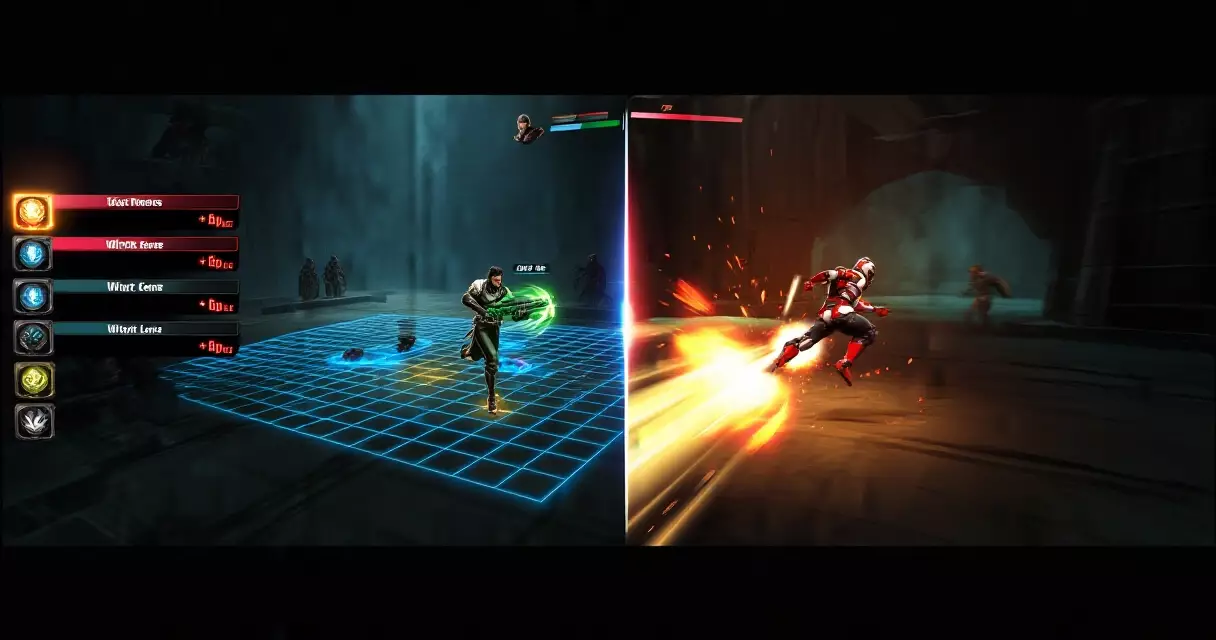
Turn-based combat has the longest history in video RPGs, tracing directly from tabletop dice mechanics. In its pure form, each combatant takes an ordered turn to act, with no time pressure. This gives players space to read ability descriptions, evaluate enemy weaknesses, manage resource pools, and consider positioning. Final Fantasy VII’s ATB (Active Time Battle) system introduced a hybrid: a turn-based framework where speed stats determined how quickly each character’s action gauge filled, adding urgency without full real-time pressure.
Baldur’s Gate 3 demonstrates the contemporary ceiling of turn-based design. Running on the D&D 5e ruleset, every combat encounter is a puzzle of action economy – each character gets a movement, an action, and a bonus action per turn. Positioning determines whether enemies have advantage on attacks against you. Environmental hazards – fire, grease, ice – can be exploited or backfire. The system rewards preparation and lateral thinking over raw stat power, which is precisely why its peak of 875,343 concurrent players on Steam (per SteamDB) represented not just nostalgia but genuine demand for deep tactical systems.
Real-time combat removes the turn structure entirely, requiring players to control movement, attack timing, ability use, and positioning simultaneously. The Elder Scrolls V: Skyrim’s first-person melee is the most mainstream example: you aim, you swing, the enemy reacts in real time. The system is intuitive for casual players but shallow by design – Skyrim’s combat is widely acknowledged as the series’ weakest component mechanically, even as its world design is its strongest. Depth is sacrificed for accessibility.
Action RPGs occupy the middle ground and currently dominate the market. Elden Ring requires genuine mechanical skill – learning enemy attack patterns, managing stamina, choosing the right moment to roll or parry – while also layering deep stat customization, build theory, and exploration-driven discovery. Dark Souls established this template and proved that demanding real-time combat could coexist with RPG depth. Diablo IV takes a different approach: its real-time action is designed around build expression rather than mechanical skill ceiling, with satisfying feedback loops emerging from optimal skill and gear combinations rather than reaction-speed mastery.
Real-Time with Pause (RTwP) systems, popularized by the original Baldur’s Gate and Pillars of Eternity, allow players to pause the game at any moment to queue orders for all party members, then resume. This preserves tactical depth while accommodating players who cannot process party management at full real-time speed. Divinity: Original Sin 2 blends inspiration from both traditions, offering a turn-based mode that is simultaneously one of the most mechanically expressive combat systems in gaming. Understanding these differences helps explain the full breadth of the genre – something we cover from a design perspective in our article on RPGs vs action games.
| Game | Combat Style | Key Mechanic | Year Released |
|---|---|---|---|
| Dungeons & Dragons (tabletop) | Turn-Based | Initiative rolls, action economy | 1974 |
| Final Fantasy VII | Turn-Based (ATB) | Active Time Battle gauge | 1997 |
| The Elder Scrolls V: Skyrim | Real-Time | First-person melee and magic | 2011 |
| Dark Souls | Action RPG | Stamina management, parry/dodge | 2011 |
| Divinity: Original Sin 2 | Turn-Based | Elemental surface interactions | 2017 |
| Elden Ring | Action RPG | Stance break, summons, Ashes of War | 2022 |
| Baldur’s Gate 3 | Turn-Based (D&D 5e) | Full action/bonus/reaction economy | 2023 |
| Octopath Traveler II | Turn-Based | Break and Boost system | 2023 |
| Sea of Stars | Turn-Based | Timed hits and combo attacks | 2023 |
| Diablo IV | Action RPG | Skill and affix synergies | 2023 |
Character Builds, Skill Trees, and Specialization
One of the defining pleasures of the RPG format is the feeling that your character belongs uniquely to you. Character builds and skill trees are the primary mechanisms that deliver this feeling. They transform a generic game protagonist into a specific expression of player identity and strategic preference.
A skill tree is a visual representation of available abilities and passive bonuses, arranged in a branching or networked structure. Investing points into nodes unlocks abilities or upgrades; unlocking deeper nodes typically requires investment in earlier ones. The tree shape creates natural archetypes – if the top branch of a Warrior tree focuses on dual-wielding and the bottom branch on shield tanking, players are making a meaningful identity choice, not just a numbers optimization.
Path of Exile’s Passive Skill Tree is the most ambitious implementation in gaming. It contains over 1,300 nodes arranged in a giant web, with each character class starting in a different position. Building a character in Path of Exile requires mapping a route through this web across dozens of hours of planning, and the community has produced dedicated external build tools (PoE Planner, Path of Building) that allow simulation before a single point is committed. The system is daunting to newcomers but has produced one of the most dedicated theorycrafting communities in the genre.
Fallout: New Vegas uses a hybrid of SPECIAL attributes (Strength, Perception, Endurance, Charisma, Intelligence, Agility, Luck) with a perk system that offers meaningful choices every two levels. The brilliance of New Vegas is that skill points determine what is possible – a 75 in Speech opens dialogue options, a 50 in Lockpick opens containers – while perks determine how those possibilities play out. Characters with identical stats but different perks feel genuinely different to play.
Respec systems – mechanics that allow players to reset and reallocate skill points – have become a standard courtesy feature in modern RPGs. Earlier games like the original Diablo punished misallocation permanently, creating a meta-game of perfect planning before any point was spent. Modern titles recognize that players discover preferred playstyles through experimentation, and locking bad choices behind a restart is more frustrating than rewarding for most audiences. Elden Ring introduced rune respecs at the cost of a rare consumable, threading the needle between consequence and accessibility.
Multiclassing, where a character takes levels in more than one class, originated in tabletop D&D and carries directly into games like Baldur’s Gate 3. A Warlock-Paladin multiclass (colloquially called a “Padlock” by the community) combines two complementary mechanics – Warlock’s Eldritch Blast and Pact Magic with Paladin’s Divine Smite – to create a short-rest recharging powerhouse that neither class achieves alone. Discovering these synergies is a core part of the genre’s appeal, and the community sharing of optimized builds has become its own subculture. If you want to explore builds across the genre’s best titles, we’ve ranked our picks in the 50 best RPG games of all time with notes on what makes each system distinct.
“Skill trees give players the feeling that the character they are playing is uniquely theirs – a mirror of decisions made across dozens of hours.”
Economy, Crafting, and Resource Management
Every RPG is also an economic simulation, even when that is not the primary framing. Whether you are managing gold in Baldur’s Gate 3, souls in Dark Souls, caps in Fallout: New Vegas, or orbs in Path of Exile, resource scarcity and allocation decisions shape the play experience in ways that parallel real-world economic behavior more than most players recognize.
The simplest economy is the gold-and-merchant model. Players accumulate currency by looting enemies, selling unwanted gear, and completing quests. They spend currency at vendors on consumables, equipment, and services. The key design tension is inflation control – if players accumulate currency faster than they can spend it meaningfully, the economy becomes irrelevant. Skyrim notoriously suffers from this: by mid-game, most players have more gold than they can spend, stripping vendor interactions of meaning. Games like Divinity: Original Sin 2 maintain currency relevance longer by scaling merchant inventories to include genuinely powerful items at prices that require deliberate saving.
Crafting systems add a production layer to the economy. Instead of simply buying or looting equipment, players gather raw materials – ore, herbs, monster parts – and combine them through a recipe system to create items. The depth varies wildly. Skyrim’s smithing is a shallow progression gate: gather leather and iron, produce gear, advance the skill. Path of Exile’s crafting system uses its currency items as crafting reagents – an Orb of Alteration rerolls a magic item’s affixes randomly, an Orb of Exaltation adds an affix to a rare item – creating a probabilistic crafting meta-game that intersects with the broader player economy. Players trade currency orbs with each other because the orbs themselves hold crafting value.
EverQuest, one of the first massively multiplayer RPGs, is the landmark case study in virtual economics. Economist Edward Castronova’s 2001 paper, published via SSRN, calculated that EverQuest’s GDP per capita, if the game were a country, would rank it 77th in the world at the time of writing. Platinum – the in-game currency – was being traded for real US dollars on eBay at rates that gave it genuine exchange value. The virtual economy was real enough to attract academic scrutiny.
Resource management extends beyond currency to consumables and rest systems. Baldur’s Gate 3 uses a long rest mechanic tied to camp supplies: resting restores spell slots and abilities but costs food resources, creating a friction point that forces players to consider their resource expenditure in dungeons rather than casting every powerful spell on every encounter. Dark Souls’ Estus Flask system is even more constrained – a limited number of healing charges that refill at bonfires, making each charge a meaningful resource commitment in a boss fight or long dungeon stretch.
These systems converge to create what game theorists call the “meaningful scarcity” principle: resources that are limited create decisions, and decisions create engagement. An RPG where healing is free, currency is infinite, and crafting materials are trivially abundant is an RPG where players are never truly invested in outcome. The economic systems of great RPGs are not obstacles – they are the conditions under which the best decisions become possible. For players building out their first serious RPG library, our full RPG master guide pairs each recommendation with notes on economic and crafting complexity.
FAQ – RPG Game Mechanics Explained
What are the core stats in most RPGs?
Most RPGs organize character capability around a set of primary attributes that govern what your character can do and how effectively. The classic template comes from Dungeons & Dragons: Strength (physical power and melee damage), Dexterity (agility, accuracy, and dodge), Constitution (health and stamina), Intelligence (spell power and knowledge), Wisdom (perception and certain magic), and Charisma (social interactions and leadership). Video RPGs adapt and abbreviate this list. The Elder Scrolls series uses Strength, Intelligence, Willpower, Agility, Speed, Endurance, Personality, and Luck in earlier entries, while Skyrim simplifies to Health, Magicka, and Stamina pools. Diablo IV organizes stats around Strength, Dexterity, Intelligence, and Willpower, each of which scales differently per character class. Secondary or derived stats – critical hit chance, resistances, attack speed, cooldown reduction – then emerge from these primary attributes and from gear affixes. The specific names change, but the underlying logic is consistent: stats create the mathematical foundation on which all other mechanics rest.
How does leveling up work in RPGs?
Leveling in RPGs works by accumulating experience points (XP) through in-game activities – defeating enemies, completing quests, exploring new areas, and in some games, using specific skills. When your total XP reaches the threshold set for the next level, your character advances. On leveling, one or more of the following happens: primary stats increase automatically, you receive points to allocate into stats or skills, new abilities unlock, and your health and resource pools expand. The XP threshold for each subsequent level is typically higher than the last, creating an escalating curve that slows advancement over time. Different games use different leveling models: traditional XP accumulation (Final Fantasy VII, World of Warcraft), skill-use-based leveling (The Elder Scrolls V: Skyrim), milestone leveling tied to story beats, or hybrid systems. The design goal in all cases is to produce a steady but increasingly spaced rhythm of advancement that keeps players engaged without making the game feel trivially fast to complete. The psychological research on this spacing, cited by Przybylski et al. (2010) in the Journal of Personality and Social Psychology, links leveling reward timing directly to intrinsic motivation maintenance.
What does “loot rarity” mean in an RPG?
Loot rarity is a hierarchical classification system that signals how powerful, rare, and desirable a dropped item is relative to other items in the same game. Rarity is almost universally communicated through color coding: white or gray for common items with basic or no special properties, green for uncommon items with minor bonuses, blue or yellow for rare items with multiple affixes or enhanced stats, purple for epic or very rare items with powerful properties, and orange or gold for legendary items with unique modifiers that fundamentally alter a build. At the top, unique or artifact items have fixed, named properties that cannot be rerolled. The rarity system matters because it provides immediate visual information during fast-paced looting, creates a psychological gradient of reward intensity (finding an orange item feels more significant than finding a white one), and structures the entire economy of the game around scarcity of higher-tier drops. In games like Diablo IV and Path of Exile, the highest rarity tiers are rare enough that players can play for dozens of hours without seeing a specific legendary, making those moments genuinely memorable.
What is the difference between turn-based and action RPG combat?
Turn-based and action RPG combat represent fundamentally different philosophies about where the challenge in combat should live. Turn-based systems give each combatant a structured opportunity to act in sequence, with no time pressure between turns. The challenge is strategic and cognitive: reading the situation, choosing the right abilities, managing resources, positioning characters optimally. Games like Baldur’s Gate 3, Final Fantasy VII, and Octopath Traveler II use this model. The player has as long as they need to think. Action RPG combat, by contrast, unfolds in real time and demands manual skill: you control your character’s movement, attack timing, ability activation, and defensive reactions simultaneously. Elden Ring and Dark Souls exemplify this – learning to dodge an enemy’s attack pattern is a physical skill that takes practice. Diablo IV is also real-time but focused less on mechanical mastery and more on build expression. Hybrid systems exist, including Active Time Battle (which adds urgency to turns) and Real-Time with Pause (which allows tactical pausing in real-time action). Neither approach is objectively superior; they appeal to different kinds of engagement and cognitive preference.
What is a skill tree and how do I use one?
A skill tree is a visual progression system that displays available abilities, passive bonuses, and character upgrades in a branching structure. Each node represents a specific skill or enhancement; investing a skill point into a node unlocks it, and deeper nodes in the tree become accessible only after earlier ones are unlocked. To use one effectively, start by identifying what playstyle you want – offensive, defensive, support, stealth – and then look for the branch of the skill tree that corresponds to that style. Avoid spreading points across multiple branches in the early game; concentrated investment unlocks more powerful nodes faster. Check whether the tree has synergies – passive nodes that enhance specific active abilities – and prioritize the active abilities you use most often. In complex games like Path of Exile, it helps to plan your intended path through the skill tree before committing, using external tools or community guides. Most modern RPGs offer some form of respec system, so mistakes are rarely permanent, but deliberate planning will make your character more efficient from the outset. The skill tree is also a communication tool: the shape and naming of branches tells you what character archetypes the developers intended and rewards.
How do crafting systems work in RPGs?
Crafting systems in RPGs allow players to create or modify items by combining raw materials, components, or reagents through a recipe or formula structure. In their simplest form – as in Skyrim’s smithing – crafting requires collecting specific materials (iron ingots, leather strips) and visiting a workbench to produce a piece of equipment. The system gates character power behind resource collection and skill investment rather than pure looting. More complex crafting systems, like those in Path of Exile or Divinity: Original Sin 2, treat crafting as a probabilistic game within the game. In Path of Exile, special currency items modify items in specific ways: rerolling modifiers, adding new affixes, changing rarity tiers, or increasing the number of sockets. Experienced crafters plan sequences of these modifications to target specific item outcomes, though randomness always plays a role. Crafting serves two design purposes: it gives players agency over gear acquisition rather than pure reliance on random drops, and it creates a resource sink that gives gathered materials ongoing value. The best crafting systems reward knowledge – understanding what is possible and how to pursue it – as much as they reward time investment.
Are RPG mechanics the same in JRPGs and CRPGs?
JRPGs (Japanese RPGs) and CRPGs (Computer/Western RPGs) share foundational mechanics – experience points, leveling, stats, equipment – but diverge significantly in how those mechanics are presented and what they emphasize. JRPGs like Final Fantasy VII, Pokémon, and Octopath Traveler II typically give players a fixed protagonist or party, with progression focused on the narrative and on mastering a specific combat system. Character customization exists but usually within a defined framework: you choose Materia in Final Fantasy VII, but Cloud is always Cloud. JRPGs tend to use turn-based or menu-driven combat, with elaborate visual spectacle around abilities. CRPGs like Baldur’s Gate 3, Divinity: Original Sin 2, and Fallout: New Vegas emphasize player-defined characters, often beginning with a deep creation screen where you allocate stats before the game starts. Choices – in character building, in dialogue, in quest resolution – have more branching consequences. Combat in CRPGs is often more tactically deep and less visually flashy. The economic and crafting systems in CRPGs tend to be more elaborate, reflecting their simulation roots. Both traditions produce excellent games; the right choice depends on whether you prioritize authored narrative immersion or open-ended player expression.
What is the best RPG for learning core mechanics?
The best RPG for learning core mechanics depends on your starting point and learning preferences, but several titles stand out as particularly clear teachers. For total newcomers, Pokémon games are genuinely excellent – they teach type matchups, stat roles, and turn-based strategy through structured tutorials and low-stakes early encounters, all wrapped in an approachable aesthetic. For players ready for more complexity, The Elder Scrolls V: Skyrim presents real-time combat and skill-based leveling in a nearly friction-free open world that lets you explore at your own pace. Its simplifications make it a lower barrier than most RPGs without being condescending. For players ready to understand RPG mechanics at a deeper level, Divinity: Original Sin 2 is arguably the most rewarding teacher – its elemental interaction system, turn-based tactics, and stat-driven dialogue create a thorough introduction to how deep RPG systems interlock. Baldur’s Gate 3, while more complex than Skyrim, has an excellent tutorial dungeon and in-game tooltips that explain D&D rules clearly enough that many players use it as their entry point to the CRPG genre. For a curated set of starting recommendations by complexity tier, our RPG master guide maps out the full landscape.
Related Reading
- RPG Games Master Guide: Best Titles, Subgenres & How to Start
- 50 Best RPG Games of All Time, Ranked by Players and Critics
- Best Multiplayer RPG Games Online: MMORPGs, Co-op & Party RPGs
- Best RPG Games for PC in 2025: Top Picks Across Every Subgenre
- Best Single-Player RPG Games That Deliver 100+ Hours of Story
- Every Type of RPG Game Explained: JRPG vs CRPG vs Action RPG
- How to Get Into RPG Games: A Beginner's Roadmap for 2025
- RPG Games vs Action Games: Key Differences, Hybrids & Which to Play
- RPG Games With the Best Stories Ever Written, According to Fans
- Upcoming RPG Games in 2025 and 2026: Every Major Release on the Radar
- Baldur's Gate 3 Review: Is It the Greatest RPG Ever Made?
- Divinity: Original Sin 2 Review — The Benchmark for Modern CRPGs
- Dragon Age: The Veilguard Review — Does BioWare Recapture Its RPG Crown?
- Elden Ring Review: How FromSoftware Redefined the Action RPG Genre
- Final Fantasy XVI Review: A Bold Action-RPG Departure
- Pathfinder: Wrath of the Righteous Review — The CRPG Fans Deserve
- Persona 5 Royal Review: Why This JRPG Is a Once-in-a-Generation Game
- The Witcher 3: Wild Hunt Review — Still Gold Standard in 2025?
Sources
- Wikipedia: Role-playing video game
- Przybylski, A. K. et al. (2010). Motivational, emotional, and behavioral correlates of fear of missing out. Journal of Personality and Social Psychology.
- Castronova, E. (2001). Virtual Worlds: A First-Hand Account of Market and Society on the Cyberian Frontier. SSRN / Indiana University.
- SteamDB: Steam concurrent player data and game statistics
- Statista (2024). Global video game market revenue by genre.
- Newzoo (2024). Global games market report: PC gamer genre preferences.
- The Pokémon Company. Official franchise sales milestones.
- Larian Studios press materials: Baldur’s Gate 3 (2023).
- Grinding Gear Games. Path of Exile game systems documentation.
- Obsidian Entertainment. Fallout: New Vegas design documentation (2010).
Gaming Laptop Buyer’s Guide: Performance, Portability & Best Models